
Pierres de Dropa
The legend: 716 granite discs discovered in 1937 in the Bayan Har mountains, bearing an inscription deciphered by a professor "Tsum Um Nui" telling of the crash of "Dropa" extraterrestrials 12,000 years ago. The reality: a documented hoax — no physical disc exists in any museum, the central figures (Chi Pu Tei, Tsum Um Nui) cannot be found in any archive, and the author of the most famous book on the subject confessed the fabrication in 1995.
- Lieu
- China (alleged) · Asie & Pacifique
- Civilisation
- —
- Période
- canular du XXe s. (récits des années 1960)
- Technique
- aucun objet réel : disques de pierre gravés de spirales allégués, jamais localisés ni exposés dans aucun musée
- Études
la preuve du faux est documentée. Photographie révisable de l’état des recherches, jamais un jugement.
→ Situer sur la carteOù se trouve le site
34.000° N, 97.000° E · vue satellite
Ce que dit la science
- Discuté entre chercheursappui réel, pas tranché
Aucun des 716 disques allégués n'est localisable dans un musée ou une collection publique ; aucune publication scientifique n'existe
« Tsum Um Nui » et « Chi Pu Tei » sont inconnus de toute archive académique ; leurs noms ne correspondent à aucune morphologie lexicale chinoise valide
David Gamon a avoué en 1995 (Fortean Times) avoir écrit sous pseudonyme le livre Sungods in Exile (1978) comme une fiction inspirée de von Däniken
Ce qui reste inexpliqué
Relié à
Études & sources
Continuer l’exploration
 Réfuté
Route de Bimini
At 5 meters' depth off North Bimini, a 0.8 km row of rectangular limestone blocks looks like a paved road. Geology settles it clearly: it is natural beachrock, a tropical phenomenon documented throughout the Caribbean basin. The controversy was born in 1968 from a calendar coincidence with an Edgar Cayce prophecy, and from our brain's ability to see order where there is only fluid physics.
 Réfuté
Sphères de Klerksdorp
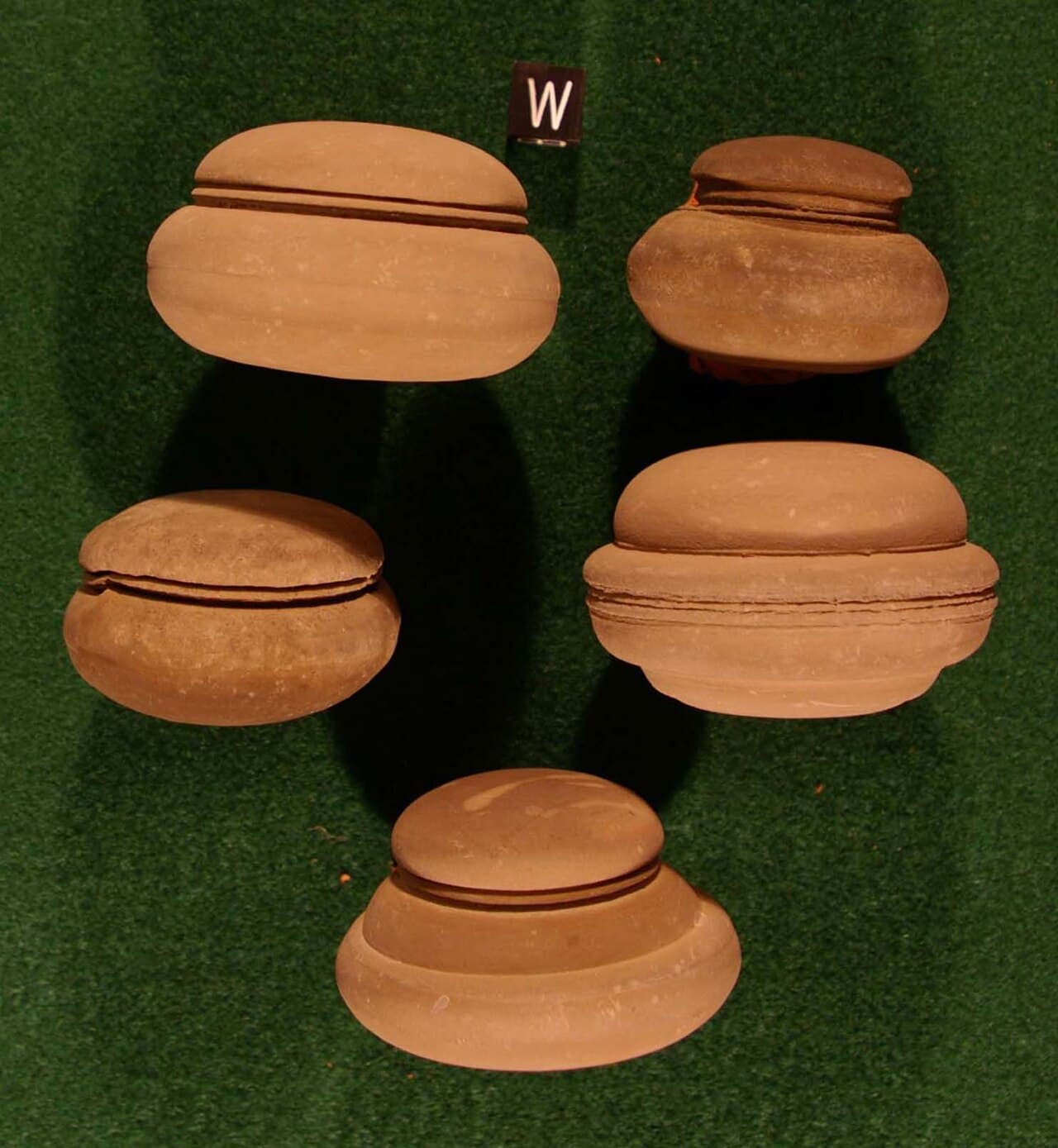
Metallic-looking spheres extracted from the pyrophyllite mines of Ottosdal (South Africa), about 3 billion years old and bearing parallel grooves, fueled the myth of an OOPArt manufactured by a civilization or extraterrestrials. In reality, these are ordinary geological concretions — pyrite, hematite or wollastonite — formed by aqueous precipitation in sediments; the grooves are merely imprints of fine sedimentary laminations, explained since 1988.
Vase de Dorchester
In June 1852, Scientific American relayed a short item from the Boston Transcript: a black-powder blast in Dorchester (Massachusetts) had allegedly uncovered a metallic vase in Precambrian rock — imagined proof of a vanished civilization. The refutation is categorical: the object is identified as a 19th-century Indian bidriware hookah base (a twin piece is catalogued at the Victoria & Albert Museum, no. 137-1852); it fell into the blast debris rather than being extracted from the rock, and the 1852 article itself gives no geological dating.