Megalitics

Recherche

Chercher un site, un artefact ou un dossier de l’atlas

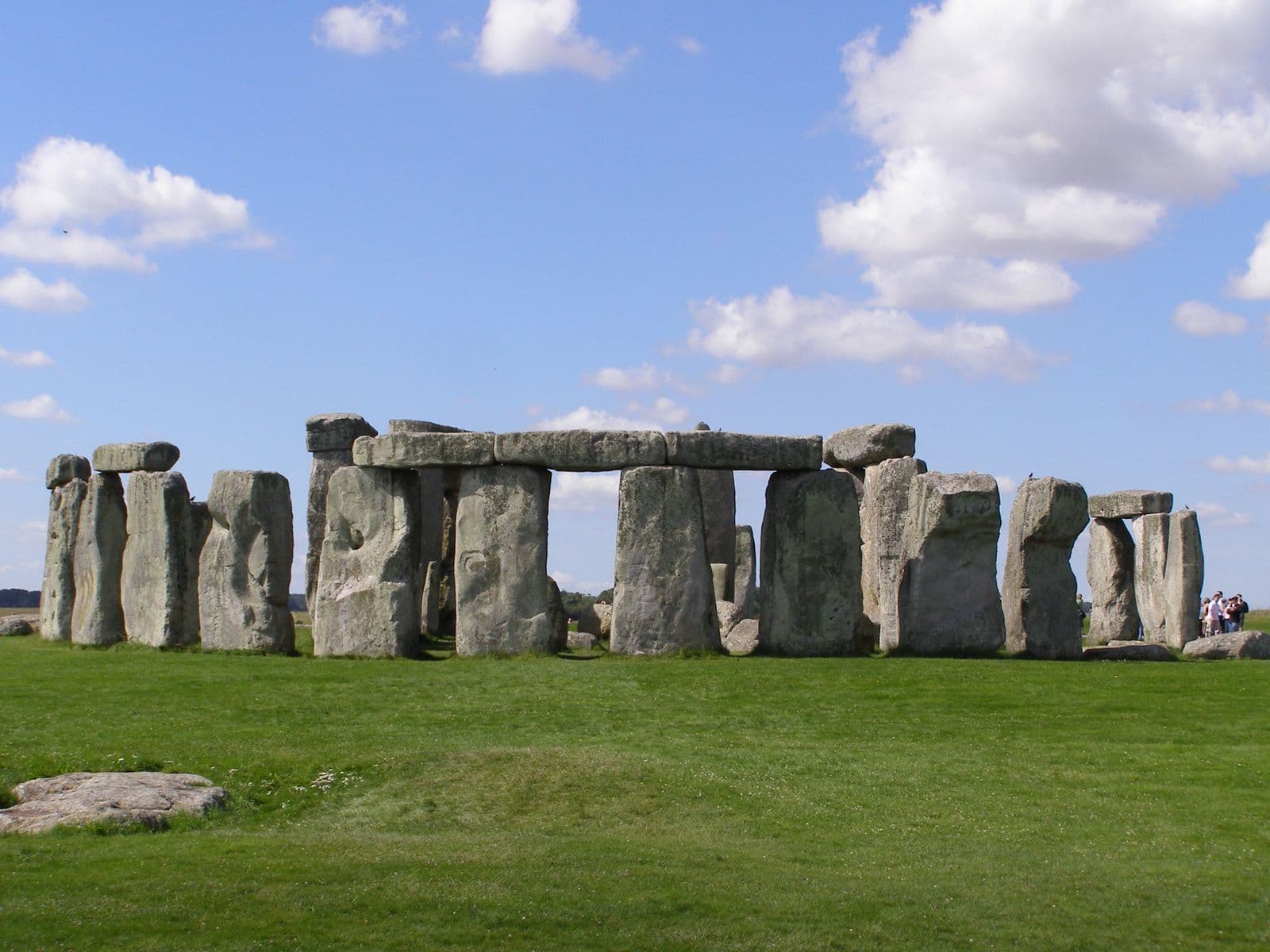
Stonehenge
En débatSite

Stonehenge

Les pierres bleues ont voyagé 250 km depuis le pays de Galles. Et la pierre d’autel, d’Écosse. Pourquoi celles-là ?

Lieu
Angleterre · Europe
Civilisation
Néolithique britannique
Période
−3000 → −2000
Technique
Sarsens de 25 t, tenons et mortaises
Études
1 000+ publications

En débatappui réel, pas tranché. Photographie révisable de l’état des recherches, jamais un jugement.

→ Situer sur la carte
En images

Les éléments du site

9 photos · Wikimedia Commons
© Diego Delso · CC BY-SA 4.0
© Ввласенко · CC BY-SA 3.0
© Bob Harvey · CC BY-SA 2.0
© Diego Delso · CC BY-SA 4.0
© Drawn by Adamsan · CC BY-SA 3.0
Localisation

Où se trouve le site

51.180° N, 1.830° O · vue satellite

🔬 Science

Ce que dit la science

  • Ce que dit la scienceconsensus, datations, fouilles publiées

    La provenance galloise des pierres bleues (collines de Preseli) est confirmée par géochimie.

  • Ce que dit la scienceconsensus, datations, fouilles publiées

    L’axe solsticial est mesuré, pas supposé : lever au solstice d’été, coucher au solstice d’hiver.

  • Ce que dit la scienceconsensus, datations, fouilles publiées

    Sépultures, crémations et dépôts font consensus sur une fonction cérémonielle et funéraire.

  • Ce que dit la scienceconsensus, datations, fouilles publiées

    Les 50 sarsens principaux (~25 t, jusqu'à 7 m de haut) proviennent de West Woods, Wiltshire, à seulement ~25 km au nord : une source locale identifiée par géochimie PXRF (Nash et al., Science Advances 2020). Deux sarsens outliers ont une provenance différente, non encore identifiée.

  • Ce que dit la scienceconsensus, datations, fouilles publiées

    La séquence de construction en 5 phases (Darvill, Marshall, Parker Pearson & Wainwright, Antiquity 2012) s'étend d'environ 3000 à 1500 av. J.-C. : Phase 1 = henge de terre et Aubrey Holes (~3000 BCE) ; Phase 2 = premières pierres bleues (~2600 BCE) ; Phase 3 = grande architecture sarsen (~2500 BCE) ; Phases 4-5 = réarrangements des bluestones (~2200–1500 BCE).

  • Ce que dit la scienceconsensus, datations, fouilles publiées

    63 individus incinérés ont été identifiés dans les Aubrey Holes, enterrés sur ~500 ans (~3000–2500 av. J.-C.). Au moins 10 sur 25 individus analysés étaient d'origine non locale ; 4 parmi les premiers enterrés sont géochimiquement compatibles avec une origine dans l'ouest du Pays de Galles (Snoeck et al., Scientific Reports 2018).

🜂 Mystère

Ce qui reste inexpliqué

thèmes & techniques

Relié à

NéolithiqueArchéoastronomieTransport mégalithiqueEurope atlantique
chaque ligne est vérifiable

Études & sources

ConsensusBevins R.E., Ixer R.A. & Pearce N.J.G. — «Carn Goedog is the likely major source of Stonehenge doleritic bluestones: Evidence based on compatible element geochemistry and Principal Component Analysis» — Journal of Archaeological Science 42 (2014), pp. 179–193ConsensusParker Pearson M., Pollard J., Richards C., Welham K. et al. — «Megalith quarries for Stonehenge's bluestones» — Antiquity 93/367 (2019), pp. 45–62Peer-reviewBevins R.E., Pearce N.J.G. & Ixer R.A. — «Revisiting the provenance of the Stonehenge bluestones: Refining the provenance of the Group 2 non-spotted dolerites using rare earth element geochemistry» — Journal of Archaeological Science: Reports 38 (2021), 103083Peer-reviewBevins R.E., Pearce N.J.G., Parker Pearson M. & Ixer R.A. — «Identification of the source of dolerites used at the Waun Mawn stone circle in the Mynydd Preseli, west Wales and its implications for the proposed link with Stonehenge» — Journal of Archaeological Science: Reports 45 (2022), 103556ConsensusNash D.J., Ciborowski T.J.R., Ullyott J.S., Parker Pearson M., Darvill T., Greaney S., Maniatis G. & Whitaker K.A. — «Origins of the sarsen megaliths at Stonehenge» — Science Advances 6/31 (2020): eabc0133ConsensusClarke A.J.I., Kirkland C.L., Bevins R.E., Pearce N.J.G., Glorie S. & Ixer R.A. — «A Scottish provenance for the Altar Stone of Stonehenge» — Nature 632/8025 (2024), pp. 570–575Peer-reviewBevins R.E., Pearce N.J.G., Hillier S., Pirrie D., Ixer R.A. et al. — «Was the Stonehenge Altar Stone from Orkney? Investigating the mineralogy and geochemistry of Orcadian Old Red sandstones and Neolithic circle monuments» — Journal of Archaeological Science: Reports 58 (2024), 104738Peer-reviewParker Pearson M., Bevins R., Bradley R., Ixer R., Pearce N. & Richards C. — «Stonehenge and its Altar Stone: the significance of distant stone sources» — Archaeology International 27/1 (2025), pp. 113–137Peer-reviewClarke A.J.I. et al. (Curtin University) — «From Highlands to Henge: Refining the Provenance and Transport Pathways of Stonehenge's Altar Stone» — Journal of Quaternary Science (2026)Peer-reviewParker Pearson M., Bevins R., Ixer R. et al. — «Reconstructing extraction techniques at Stonehenge's bluestone megalith quarries» — Journal of Archaeological Science: Reports 46 (2022), 103697Peer-reviewBevins R.E., Pearce N.J.G., Ixer R.A., Scourse J., Daw T., Parker Pearson M. et al. — «The enigmatic 'Newall boulder' excavated at Stonehenge in 1924: new data and correcting the record» — Journal of Archaeological Science: Reports 66 (2025), 105303Peer-reviewBevins R.E., Ixer R.A., Pearce N.G., Scourse J. & Daw T. — «Lithological description and provenancing of a collection of bluestones from excavations at Stonehenge by William Hawley in 1924 with implications for the human versus ice transport debate» — Geoarchaeology 38 (2023), pp. 771–785AlternatifJohn B. — «A bluestone boulder at Stonehenge: implications for the glacial transport theory» — E&G Quaternary Science Journal 73 (2024), pp. 117–126 [position minoritaire, contestée par Bevins et al. 2025]ConsensusDarvill T., Marshall P., Parker Pearson M. & Wainwright G. — «Stonehenge remodelled» — Antiquity 86/334 (2012), pp. 1021–1040Peer-reviewDarvill T. & Wainwright G. — «Stonehenge excavations 2008» — The Antiquaries Journal 89 (2009), pp. 1–19ConsensusParker Pearson M., Chamberlain A., Jay M., Marshall P., Pollard J., Richards C., Thomas J., Tilley C. & Welham K. — «Who was buried at Stonehenge?» — Antiquity 83/319 (2009), pp. 23–39ConsensusWillis C., Marshall P., McKinley J., Pitts M., Pollard J., Richards C., Richards J., Thomas J., Waldron T., Welham K. & Parker Pearson M. — «The dead of Stonehenge» — Antiquity 90/350 (2016), pp. 337–356ConsensusSnoeck C., Pouncett J., Claeys P., Goderis S., Mattielli N., Parker Pearson M., Willis C., Zazzo A., Lee-Thorp J.A. & Schulting R.J. — «Strontium isotope analysis on cremated human remains from Stonehenge support links with west Wales» — Scientific Reports 8 (2018), 10790ConsensusRuggles C.L.N. — «Astronomy and Stonehenge» — in Cunliffe B. & Renfrew C. (éds), Science and Stonehenge, Proceedings of the British Academy 92 (1997), pp. 203–229. Oxford University PressAlternatifDarvill T. — «Keeping time at Stonehenge» — Antiquity 96/386 (2022), pp. 319–335AlternatifMagli G. & Belmonte J.A. — «Archaeoastronomy and the alleged 'Stonehenge calendar'» — Antiquity 97/393 (2023) [réfutation de Darvill 2022]Peer-reviewParker Pearson M., Pollard J., Richards C. et al. — «The original Stonehenge? A dismantled stone circle in the Preseli Hills of west Wales» — Antiquity 95/379 (2021), pp. 85–103ConsensusParker Pearson M. (2012). Stonehenge: Exploring the Greatest Stone Age Mystery. Simon & SchusterConsensusCleal R.M.J., Walker K.E. & Montague R. (1995). Stonehenge in its Landscape: Twentieth-Century Excavations. English Heritage Archaeological Report 10, LondonConsensusHistoric England — Astronomical research at Stonehenge (axe solsticial)
À découvrir

Continuer l’exploration